
At Angel Academy, we are proud to announce the recent publication of the scientific article ‘Proposal of a new atache design for tip movement optimization with clear aligners’, developed by Dr. David Gonzalez Zamora and Dr. Romina Vignolo Lobato, Angel Academy lecturers and members of the Clinical Advisory Board of Angel Aligner.
This study represents a significant advance in improving the predictability of orthodontic movements with clear aligners, addressing one of the most complex challenges in this type of treatment: mesiodistal tip control.
In the last decade, clear aligners have become an effective and aesthetic option for orthodontic treatment. However, certain movements, such as tip and torque, continue to present challenges in terms of accuracy and predictability.
Tip movement, which involves the controlled tilting of the tooth root relative to the crown, is particularly difficult to achieve with clear aligners. Despite advances in 3D planning software and material optimisation, clinical results often do not accurately reflect the digital planning prescription.
Currently, different strategies are employed to improve tip expression, such as the use of rectangular attachments, double attachments or even power arms in more complex cases. However, these techniques do not always achieve optimal biomechanical efficacy, which may prolong treatments and require the fabrication of additional aligners.
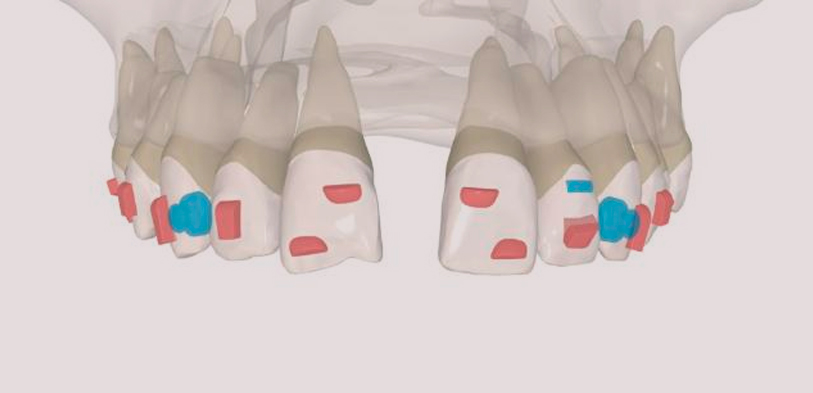
The study published by Dr David Gonzalez Zamora and Dr Romina Vignolo Lobato proposes a new atache design, developed to improve tip control and optimise the biomechanics of aligner treatment.
Through a comparative analysis, the efficacy of the new Double Gripping Zag attachment (DGZ) was evaluated against the classical double attachment, which is widely used in systems such as Invisalign. A combined approach was used, including a theoretical biomechanical analysis based on physical models and calculations of forces applied during treatment.
This new atache design has proven to be more efficient in the transmission of three-dimensional forces, allowing:
When an aligner fails to correct the tip according to the digital planning, the consequences can be significant:
Longer treatment time and need for additional refinements.
Increased workload for orthodontists and laboratories.
Increased use of resources and materials, increasing costs and the environmental footprint.
Therefore, improving the predictability of these movements not only benefits professionals and patients, but also optimises the production circuit of clear aligners.
The publication of this study marks a significant advance in the field of orthodontics with clear aligners. The proposal by Dr. David González Zamora and Dr. Romina Vignolo Lobato represents an innovation in the control of tip movement, offering a more efficient and predictable alternative for orthodontic treatment with aligners.
At Angel Academy, we remain committed to training and developing new biomechanical strategies that allow orthodontists to achieve more predictable and efficient results in their treatments.
Want to learn more about this new atache design and its clinical application? Follow us on Angel Academy and keep up to date with the latest innovations in digital orthodontics!